

 Elias Tzoc has come a long way since he first arrived in the United States in 1995. A native of Totonicapán, Guatemala, he moved to Washington state to attend Edmonds Community College as part of a program to bring high school students from Central America and the Caribbean to the U.S. He initially lived with a host family and says he only spoke a few words of English at the time. Today, he serves as the associate dean of Teaching, Learning and Research for Clemson Libraries, overseeing most of the public-facing services the Libraries provides. He was recently invited to join the Association of Research Libraries Leadership Fellows program, a nationally selective program that is designed to prepare the next generation of senior leaders in research libraries and archives.
Tzoc remembers being inspired by his experience in American higher education during his time at Edmonds, especially the library, which was the biggest one he had ever seen at that point in his life. After completing his associate’s degree in information technology, he returned to Guatemala, where he earned a bachelor’s in information systems management from Galileo University. His first job was working as web and IT coordinator for Rafael Landivar University, and part of his job was helping set up computer labs in rural Guatemala where people did not have much access to technology at the time.
“Guatemala had a civil war from the 1960s to the 90s, and certain areas were devastated. The infrastructure wasn’t there,” he said. “So with the help of a U.S. agency, we were able to create these computer centers. People were happy to have new computers and printers, but we realized that we didn’t have much content for them … so that led me to think, ‘What if we create the content?’”
Tzoc and his team worked to create content for students and teachers, which he says is an early version of what is now called Open Educational Resources (OERs). That work is what introduced him to a career path in libraries.
Tzoc came back to the U.S. on a fellowship to earn a master’s degree in information science from the University of Texas at Austin. As he was completing that degree, his adviser pointed him to a job opportunity at Miami University in Ohio, where Tzoc worked from 2007 until he came to Clemson in 2022.
At Miami, Tzoc started out as a digital initiatives librarian, where he did web programming for the library’s digital collections. His position evolved and grew over time, and he was eventually named head of the Create and Innovate Department in 2018. During that time, he learned about the Association of Research Libraries (ARL), a selective organization of the top research libraries in the U.S. and Canada.
When he was encouraged to apply for the associate dean position at Clemson Libraries in 2022, he thought that Clemson had the potential to join the ARL. He was right — Clemson was selected for ARL membership earlier this month.
“It’s important because the learning and networking opportunities through ARL are beneficial to everybody at the Libraries,” he said. “Through ARL, I am learning about the trends and priorities at other research libraries, which validates a lot of what we are doing. Being an ARL library allows us to be more proactive in learning about and responding to the needs of higher education in general … It’s a win-win.”
Tzoc was also recently selected to take part in ARL’s Leadership Fellows program, which is a 13-month hybrid program. Tzoc was selected for the program before Clemson’s selection to join ARL, making him one of only three people from non-member institutions selected for the cohort.
“It is an excellent way to connect with others and learn in a cohort environment,” he said. “What makes it unique is that it’s a group that is committed to enhancing our abilities and aligning what we do with institutional priorities.”
Tzoc’s division in Clemson Libraries — Teaching, Learning and Research — is the largest and most public-facing of all of the Libraries’ divisions, and encompasses four areas: user services, which includes the service desk, circulation, stacks management and security; teaching and learning, which includes all the subject specialist librarians who assist students and faculty with research; open scholarship, which includes affordable learning initiatives, open access publishing support, research and data services, as well as the Adobe Studio and Makerspace and the Data Visualization Lab; and Clemson University Press, which publishes books, OERs and open-access journals.
“To summarize what we do in Teaching, Learning and Research, it’s all about faculty and student success,” he said. “We proactively align everything we do to meet the needs of our students and faculty.”
Two emerging areas that Tzoc is especially interested in are AI literacy and research infrastructure. He said that libraries have a critical role to play as the use of AI increases in daily life. His team is working to ensure that the Libraries are a part of the conversation about AI at Clemson, and he is involved with TEACH-AI: Teaching and Exploration Community Hub for AI at Clemson with the Office of Teaching Effectiveness and Innovation.
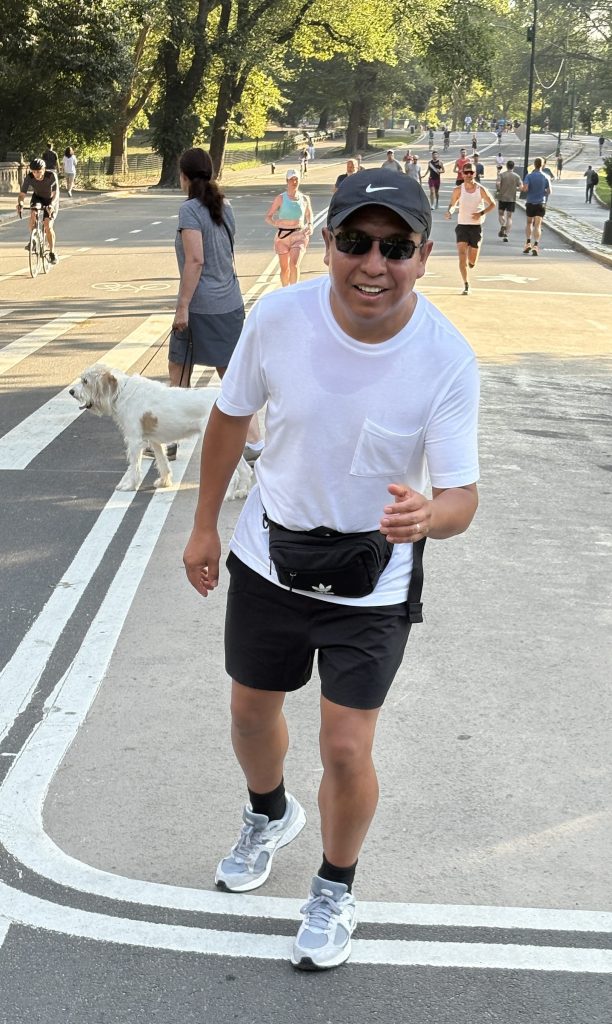
Tzoc running in Central Park on a visit to New York
“One of the roles of libraries is information literacy, and AI is another layer of that,” said Tzoc. “It’s our responsibility to help students understand the pros and cons of AI. It’s a powerful technology. People in industry are asking what universities are doing to prepare students to use it. There’s an expectation for everyone to be ready for an AI-empowered world, but we know if we don’t teach people to use this technology responsibly and ethically there’s a huge risk of problems.”
As for research, his team is proactively consulting and collaborating with the Provost’s Office, the Division of Research, and CCIT to revamp library research services in alignment with Clemson’s research priorities. He is currently championing the development of a Research Impact and Analytics service, which is an emerging service at R1 and AAU institutions. This service integrates expert personnel with access to specialized tools for analyzing and communicating research metrics.
“These services play a critical role in supporting both individual researchers and institutional administrators by generating customized impact reports,” he said. “Such reports enhance institutional visibility and demonstrate research impact at local, national, and international levels — an increasingly important capability in today’s competitive research landscape.”
Tzoc said one thing he wants people to know about Clemson Libraries is that everything is very intentional.
“We are always intentional in aligning our services to meet the evolving needs and expectations of Clemson’s faculty and students,” he said. “That is a key element in everything we do.”
Outside of work, Tzoc enjoys running, hiking with his family, cooking and watching soccer. He hopes to see Guatemala’s national team qualify for the World Cup next year for the first time ever.