

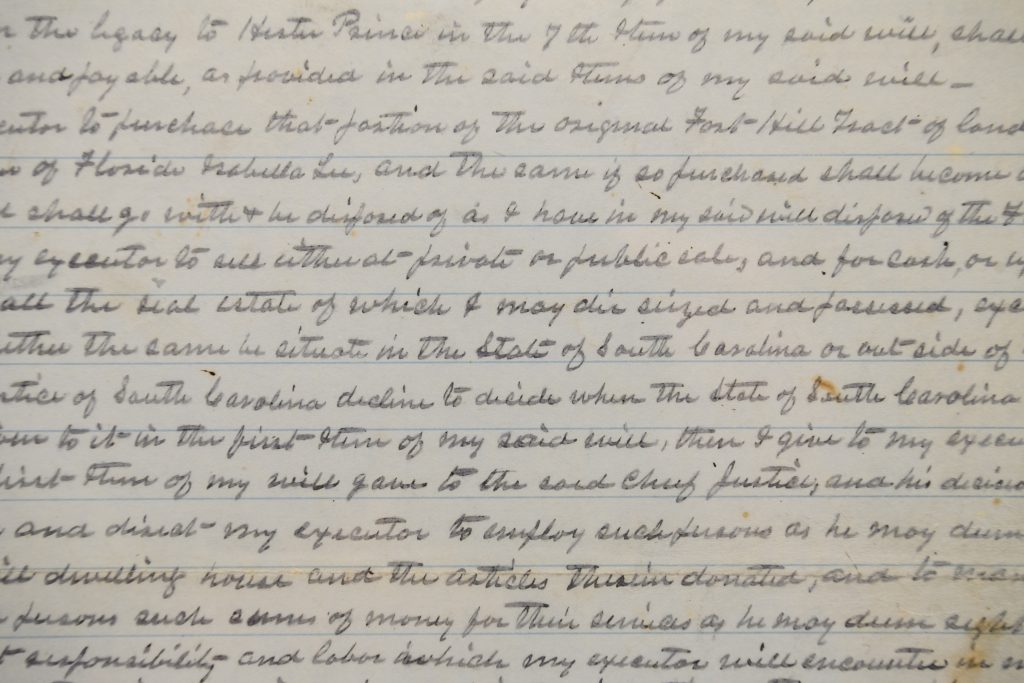
 Clemson Libraries has received an award of more than $26,000 from the Lyrasis Catalyst Fund for a project to assess handwritten text recognition (HTR) AI platforms that are used to digitize historic documents. The Libraries also received the Sandy Nyberg Award from Lyrasis, which recognizes proposals that demonstrate the highest levels of innovation in the areas of preservation, conservation, collections, writing and publishing.
The funds will be used to develop a tool that libraries, museums and other organizations can use to test and evaluate HTR platforms, helping them make informed decisions based on their needs and budgets.
The project grew out of Deeds Unbound, which involves digitizing and transcribing 19th-century handwritten property records in Pickens County. The team working on that project was looking for a faster way to transcribe documents, work that is currently being done manually by graduate students.
“We were looking for something to speed up that process, but there isn’t a lot out there in terms of evaluating these tools, so we’re starting from scratch,” said Chris Vinson, head of digital strategies for Clemson Libraries. “A lot of libraries and museums are facing similar issues in terms of limited funds and resources, so we wanted make this available to help other institutions doing the same work.”
Kelly Riddle, director of digitization and digital projects, and Jessica Serrao, digital collections metadata librarian, are also working on the project. Professors Susanna Ashton, from the Department of English, and Brent Morris, from the Department of History and Geography, are serving as consultants on the project.
The assessment tool will look at criteria such as cost, speed and accuracy of transcription, additional resources needed to employ a platform, and the output produced and how easy it is to integrate into a library’s collection.
“We have talked with other institutions doing this kind of work, and transcription is always the hardest and most time-consuming part,” said Serrao. “The technology is constantly changing, so we want to create something that is adjustable and is scalable to this rapidly changing environment.”
Lyrasis is a non-profit member organization that serves academic and public libraries, scholarly research, archives, museums and galleries. The Catalyst Fund is an award program that provides support for new ideas and innovative projects from Lyrasis members that have the potential for community-wide impact. Five projects from across the country are chosen each year.