
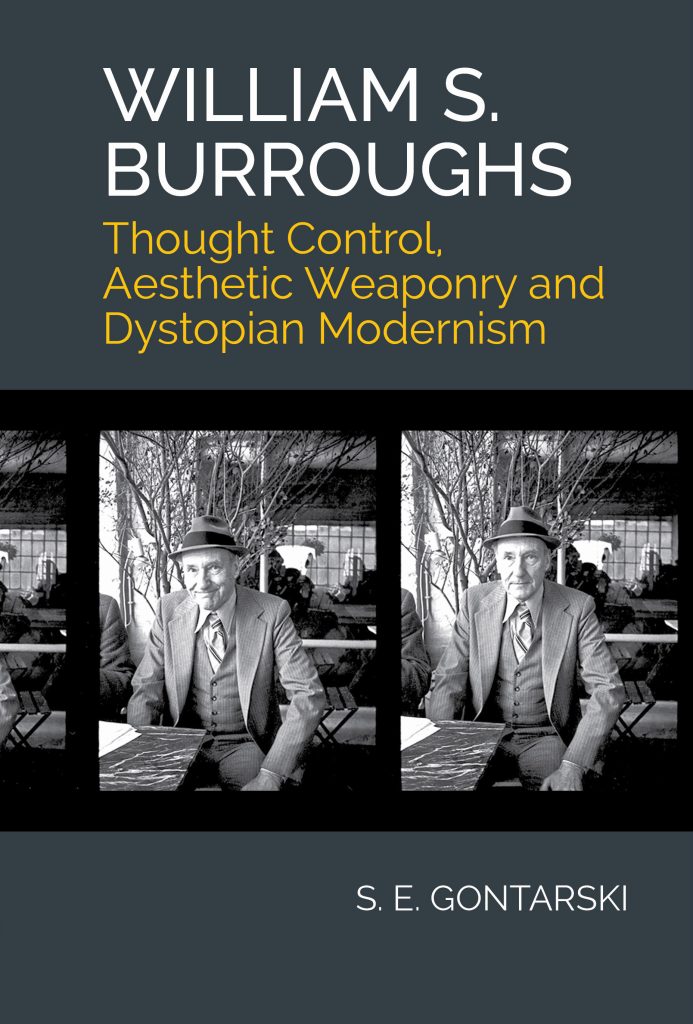
William S. Burroughs
Thought Control, Aesthetic Weaponry, and Dystopian Modernism
S. E. Gontarski
Once the notoriety of his reputation is set aside, critics and scholars have generally agreed that William S. Burroughs is one of the most innovative experimental writers and visual artists of the twentieth century, yet few critics and scholars have examined the nature or measured the scope of that innovation in the variety of media in which he worked, literature, film, sound tape and live performance, and none has fully explored the symbiotic relationship between archive or “word hoard” and the varieties of its published, performed and exhibited outcomes, from collaged and printed texts, to performances live and recorded, to gallery exhibitions. Such projects, both creative and critical, moreover, simultaneously critique the nature of texts, textuality and performativity—such interventions, engagements and reengagements acutely central to Burroughs’s creative enterprise.
Burroughs’s work, furthermore, at root, in all of its media and the variety of its voices, is bitingly, acerbically, ruthlessly comic and even satiric, its techniques repetitive, recombinant and performative from the first, his themes or targets social control (racial, sexual, chemical) and resistance to it, his mode of expression neither the novel per se, nor even the book as a discrete unit, but the cut-up, the “routine,” the fragment and their performance as writing and its extension through bodily expression. Those routines, those pieces, those fragments, pre-existing from multiple sources, internal and external, ratiocinative or chemically induced hallucinations, were often collected, organized and collaboratively edited by others into wholes like Naked Lunch. This study takes the measure of Burroughs’ impact as a cultural force and pays particular attention to the almost unknown Burroughs archive at Florida State University.
About the Author
S. E. Gontarski edited the Journal of Beckett Studies from 1989-2008. He has also edited The Beckett Critical Reader: Archives, Theories, and Translations (2012) and The Edinburgh Companion to Samuel Beckett and the Arts (2014), both from Edinburgh UP, as are his monographs, Creative Involution: Bergson Beckett, Deleuze (2015) and Beckett Matters: Beckett’s Late Modernism (2016). Revisioning Beckett: Samuel Beckett’s Decadent Turn appeared from Bloomsbury in 2018; and his Burroughs Unbound: William Burroughs and the Performance of Writing was issued by Bloomsbury in 2021. Włodzimierz Staniewski and the Phenomenon of “Gardzienice," ed. with Tomasz Wiśniewski and Katarzyna Kręglewska appeared from Routledge, also in 2021. Two volumes of his essays on Beckett’s theatre have been translated into Portuguese and published by Giostri Editora in Brazil (2021, 2022).
“Gontarski’s book is unique for the way its own research methodology mirrors its critical thesis about Burroughs’ work, which is seen as a ‘Neuromatic network,’ an ongoing archive of primary materials across many media, a rhizome of sources, a recursive structure that defies the flow of narrative frameworks or the stability of fixed forms. Drawing most heavily on Deleuzian theory, but also digressing into a multitude of fields, the book therefore shifts attention away from the oeuvre of familiar canonical texts to the larger creative and critical systems that frame it. Also striking is how Gontarski gives priority to supposedly minor works (Blade Runner is the only text analysed at length) and marginal figures (François Bucher in particular), while presenting a series of backstories through an array of facsimile documents. With a recurrent focus on Florida State University, the book offers densely detailed engagements with the dubious politics of archival acquisition, access, and taxonomic cataloguing that add up to a timely and forceful critique of the institutions that shape not just the reception of Burroughs’ work but, more crucially, its production.”
– Professor Oliver Harris, President of the European Beat Studies Network
“Part detective tale, part institutional critique, part scholarly manifesto, and wholly compelling, Gontarski’s study digs deep into the archives and emerges with an urgent warning for the academy and a pile of evidence that Burroughs’s work still has plenty to teach us. The archival material included is a true boon for readers and scholars of twentieth-century literature, but the frank exploration of contemporary “regimes of power” is absolutely vital for us all. Gontarski brings to William S. Burroughs’s archive the same rigor, vigor, and attention to detail that has defined his field-altering work on Samuel Beckett, and I expect this study to similarly inspire and shape a new wave of serious scholarly attention to Burroughs as writer, artist, “immoral amoral comedian,” and philosopher. As in Gontarski’s early work, the prose is nearly as thrilling as the scholarship, resulting in the rare academic page-turner. And he brings a breadth of knowledge about Burroughs’s rhizomatic network of projects, remarks, and exploits that invites readers rather than intimidating them. The Burroughsian ‘Neuromatic’ network—represented both in Burroughs’s work and in Gontarski’s own wide-ranging and productively recursive approach—emerges as the antidote to regimes of control and their sometimes arbitrary, shifting, self-interested acts of recklessness and casual destruction. In attending to the afterlives of intentionally Neuromatic creation and institutional destruction, Gontarski recounts and continues a project of re-activation, expansion, and fruitful new intersections. Never-before-published typescripts reveal new dimensions in and connections across Burroughs’s work; never-before-published correspondence sheds new light on Burroughs’s biography, process, and philosophy; and Gontarski’s fluency in the larger biography and bibliography (of letters, lectures, columns, marginalia, revisions, and better- and lesser-known works) of Burroughs ties it all together. There is no better guide through the literary archives than S.E. Gontarski, and that’s a good thing for us, because the journey Gontarski recounts plays like something from the pages of a Burroughs novel: strange intersections of disease and natural disaster, ego and indolence, big personalities, institutional labyrinths…Gontarski’s frustration is justified and on-display. But his perseverance is inspiring; the archival treasures he unpacks are illuminating; and the reader’s journey through Gontarski’s text is an absolute pleasure.”
– Paul Ardoin, Brackenridge Endowed Associate Professor in Literature and the Humanities, University of Texas at San Antonio
Related Books

Details
Published: November 2026
Formats
Hardback
ISBN: 978-1-63804-054-5
eBook
ISBN: 978-1-63804-055-2
Subjects
LiteratureModernism