
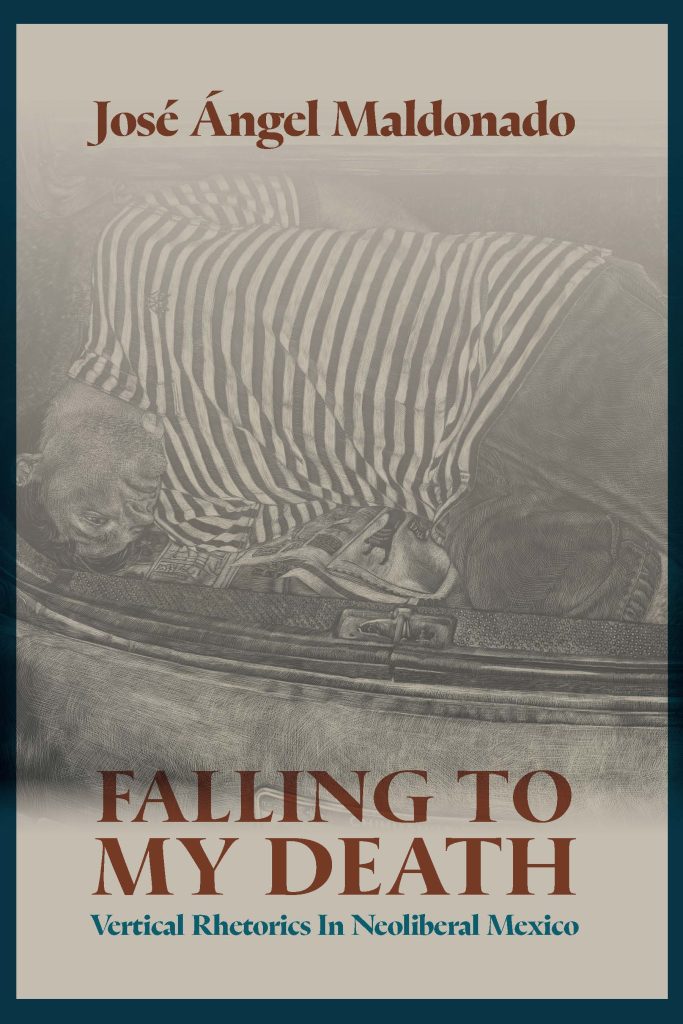
Falling to My Death
Vertical Rhetorics in Neoliberal Mexico
José Ángel Maldonado
Winner of the 2026 Diamond Anniversary Book Award from the National Communication Association
In a book that combines memoir and cultural criticism of visual media, public rhetoric, and memory texts, José Ángel Maldonado reflects on the subjectivities he embodies—mestizo, epileptic, and exile—while engaging in a critique of the various popular texts he encounters while travelling through Mexico after living in the United States as an undocumented immigrant. Using the suffix -cide (from the Latin caedere, “to fall,” and “to die”) as a guide for a discussion of modes of dying in contemporary Mexico, he creates a constellation of terms like suicide, magnicide, genocide, and feminicide, as metaphors for falling that define quotidian life in Mexico. This exercise uncloaks what he terms the “rhetorics of verticality” that many deploy when navigating dangerous situations throughout violent, militarized Mexico. Trained as a cultural critic who uses rhetorical theory to deconstruct discourse, Maldonado combines a confessional style with an accessible academic voice to demonstrate how everyday texts inform and shape reality in order to anticipate, rather than react to, the inevitability of violence.
Ebook available to libraries exclusively as part of the JSTOR Path to Open initiative.
About the Author
José Ángel Maldonado is Assistant Professor of English at the University of South Florida. He specializes in Rhetorical Theory, Critical and Cultural Studies, Film and Television Criticism, Mexican Culture, Gender Studies, Globalization, and Indigeneity. He received his PhD from the University of Utah. His research deconstructs discourses emerging in Latin America that normalize violent conditions so that we may anticipate and prevent violence of various types. His work appears in Rhetoric & Public Affairs, Communication and Critical/Cultural Studies, Southern Communication Journal, and Javnost-The Public: Journal of the European Institute for Communication and Culture.
Maldonado’s text interrogates binaries like life and death and extraordinarily provides a theoretical account of collective experience through unique occurrences. Importantly, through autoethnographic and metaphoric incisions, his interrogation of his former undocumented status insists that scholars listen to the words of the “so-called voiceless.” This powerful examination of neoliberal rhetoric in Mexico tempers rhetorical theory and criticism with personal narrative. The entire project pushes communication scholars to understand intellectually and viscerally the rhetoric and life of Mestizaje and Mexico as a whole.
— 2026 Diamond Anniversary Book Award from the National Communication Association
Related Books
 Purchase Hardback
Details
Published: December 2025
Formats
Hardback
ISBN: 978-1-63804-202-0 PRICE: $95
eBook
ISBN: 978-1-63804-203-7
Subjects
RhetoricSeries
Rhetoric and Conflict