By Neil Mann
International Yeats Studies (9:2) is a Special Issue, “W. B. Yeats’s Rapallo Notebooks: Descriptive and Analytical Examinations of the Five Rapallo Notebooks,” with essays by Neil Mann and Wayne K. Chapman. IYS 9:2 is available in Open Access or for sale as a hardback or paperback.
What is the fascination of manuscripts and drafts? After all, the final product is the thing that a writer wants the readers to see, not the false starts or first attempts at expressing an idea. And with most writing, the last thing we readers want is more to read—you don’t want to see the clumsy draft of this blog post. But when we’re dealing with a significant writer and the writing is a great poem? Or an important play? Or the explanation of a complicated idea? Then there is the prospect of “the road not taken” (in Robert Frost’s words), of another way of expressing an idea, of seeing a possibility that never reached final form in the process of creation, rejection, and refinement.
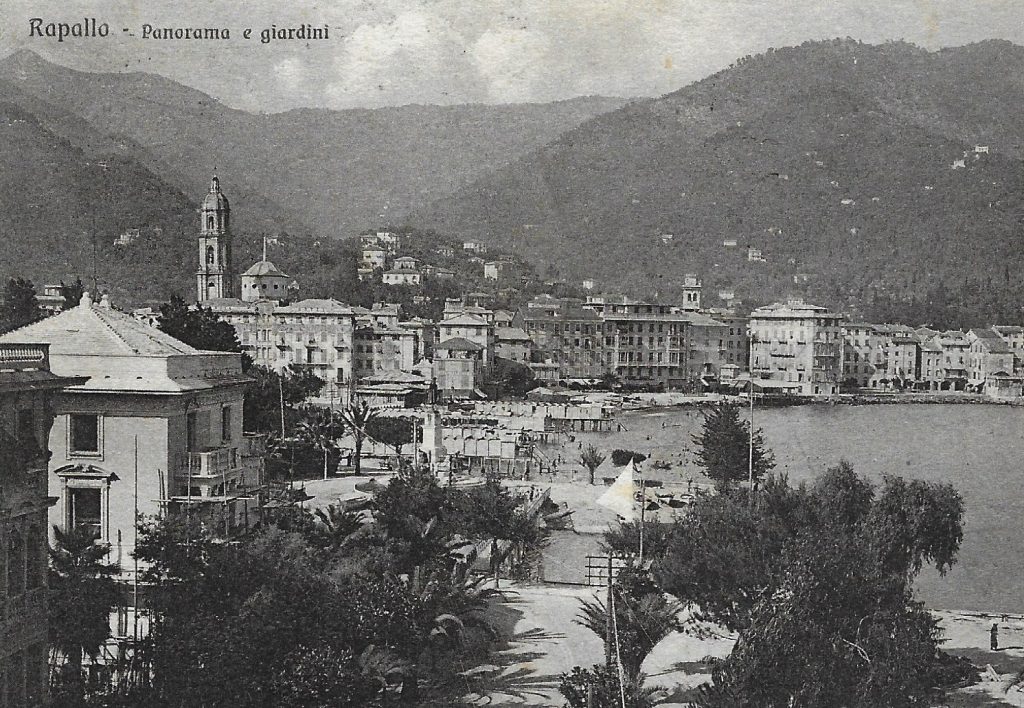
W. B. Yeats is one of the twentieth century’s most important writers in English, and we are lucky to have a good number of manuscripts that show the creative process behind his works. Generally, Yeats liked working with loose-leaf paper that he could organize, discard, and rearrange efficiently, but when he was traveling or abroad, he would often use notebooks that gather up a mix of interests and projects. Of these, the notebooks that he used at the end of 1920s when he spent his winters in Rapallo, Italy, are particularly rich and rewarding. These are now available to researchers at the National Library of Ireland, and Yeats’s biographer Roy Foster observes they “contain the drafts of so many of his new ideas” that they are “sacred objects in the great Yeatsian mine of manuscripts. The entries and outlines, jammed together in close proximity, show how freely and excitedly he was writing in his sunny eyrie above the road to Portofino” (W. B. Yeats: The Arch-Poet, 1915–1939 [2003], 385).
The essays collected here present a comprehensive study of the five notebooks that Yeats used to draft important works in verse and prose between March 1927 and April 1931, including lyrics for Words for Music Perhaps and The Winding Stair and Other Poems, with major poems such as “Coole Park, 1929” and “Byzantium”; two of his supernatural plays, The Words upon the Window-Pane and The Resurrection; articles on Irish political life; and his esoteric opus, A Vision, along with A Packet for Ezra Pound. The Rapallo Notebooks offer a unique record of Yeats’s creative processes at a key period of his artistic and personal life. Poetry, articles, plays sit alongside mysticism, reading lists, and the sketch of a week’s appointments
This volume brings together essays on Rapallo Notebooks A, B, C, and D, previously published individually in International Yeats Studies, as well as two new sections: an introductory overview and a treatment of the fifth notebook, Rapallo E. They are illustrated with nearly forty facsimiles and photographs, and they include extensive transcriptions of previously unpublished material, as well analysis of the notebooks’ structure and usage. The volume includes appendices that give tabular summaries of the notebooks’ contents page by page, which are keyed to published versions to aid researchers.
Wayne K. Chapman and I have both worked for many years on the work of W. B. Yeats, WKC focusing on poetry and drama, while I have concentrated on Yeats’s esoteric work, particularly <em>A Vision</em>. Chapman taught for twenty-five years as a professor of English at Clemson University, and served as the founding editor of Clemson University Press for sixteen of those years. Both of us have published other works with Clemson, with Chapman’s work including “Something that I read in a book”: W. B. Yeats’s Annotations at the National Library of Ireland (2 vols.) (2022), The W. B. and George Yeats Library: A Short-title Catalog (2019), Rewriting “The Hour-Glass”: A Play Written in Prose and Verse Versions by W. B. Yeats (2016); Mann’s including A Reader’s Guide to Yeats’s “A Vision” (2019) and the co-edited volumes of Yeats, Philosophy, and the Occult (2017) and W. B. Yeats’s A Vision: Explications and Contexts (2012).
We’ve both known these notebooks for many years. This project for International Yeats Studies was first conceived by WKC almost ten years ago, and for us it is a satisfying conclusion to bring everything together and to present it in one volume, both online and as a physical book, and we are hugely grateful to International Yeats Studies, particularly the two editors Lauren Arrington and Rob Doggett, and to Clemson University Press, as publisher, particularly John Morgenstern and Alison Mero, as directors.