
Words to the Wise
Women, Writing, and the Resistance of Fable in Eighteenth-Century Britain
Martha F. Bowden
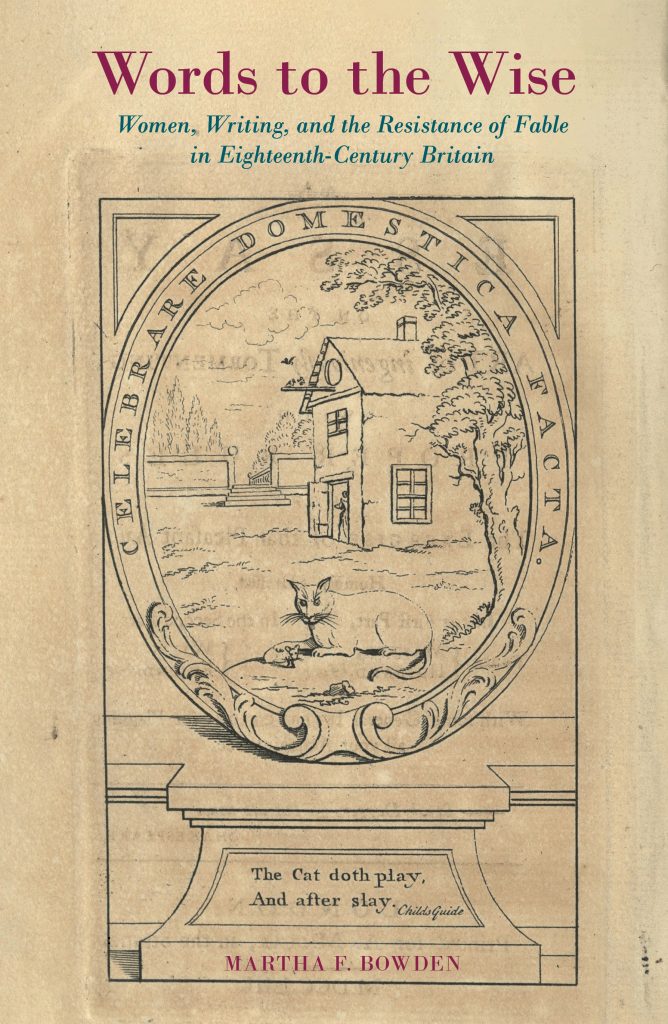
In Words to the Wise: Women, Writing, and the Resistance of Fable in Eighteenth-Century Britain, Martha F. Bowden argues that, rather than producing standalone collections of Aesopian fables, women writers of the first seventy-five years of the eighteenth century took components of the fable and embedded them in other forms, resulting in the fabular hybrid. This strategy allows them to claim the moral authority implied in the writing of fables, in order to resist the demeaning description of women’s lives and abilities in the male-authored fables directed towards women. In addition to the witty Aesop, the text also draws on The Arabian Nights’ Entertainments and Scheherazade’s successful reform of Schahriar that saves her life and the lives of the other women of her country. The critical framework is built on both modern feminist criticism and historical studies of the fable and The Arabian Nights. Bowden intentionally includes a variety of forms, the novel, the oriental tale, satire, and plays, in order to display the breadth of female writers’ use of the fabular hybrid. She also avoids privileging the novel, which feminist literary history has done for too long. Taking a wide view of the varieties of forms in which women wrote in the eighteenth century is vital to understanding their contribution to literary history.
About the Author
Martha F. Bowden, Professor Emerita of English, Kennesaw State University, is a literary historian whose publications include an edition of three of Mary Davys’s novels, The Reform’d Coquet, Familiar Letters Betwixt a Gentleman and a Lady, and The Accomplish’d Rake (Kentucky, 1999), Yorick’s Congregation: The Eighteenth-Century Church of England in the Time of Laurence Sterne (Delaware, 2007), and Descendants of Waverley: Romancing History in Contemporary Historical Fiction (Bucknell, 2016), and articles and book chapters. Current research interests include Sterne and narrative medicine, Woolf’s Orlando, Samuel Pepys, and the Covid pandemic. She is the editor of the Pedagogy section of SEASECS annual publication, New Perspectives on the Eighteenth Century.
Preface
Section I: Methodology, Definitions, and Illustrations of the Fabular Hybrid
Chapter 1 Defining the Female-Authored Fabular Hybrid
Chapter 2 The Uses of the Fabular Hybrid
Section II: Resisting the Male Narrative
Chapter 3 Men Explain Things to Women: The Male-Authored “Fables for Ladies”
Chapter 4 Women Explain Things: The Fabular Hybrid as Resistance
Chapter 5 Telling Her Own Story: The Fabular Hybrid as Life Writing
Section III: The Fabular Hybrid as Social Commentary
Chapter 6 Satiric Fabular Hybrids
Conclusion: The Words to the Wise
Related Books

Details
Published: January 2027
Formats
Hardback
ISBN: 978-1-63804-261-7
eBook
ISBN: 978-1-63804-262-4
Subjects
LiteratureSeries
18th-Century Moments