
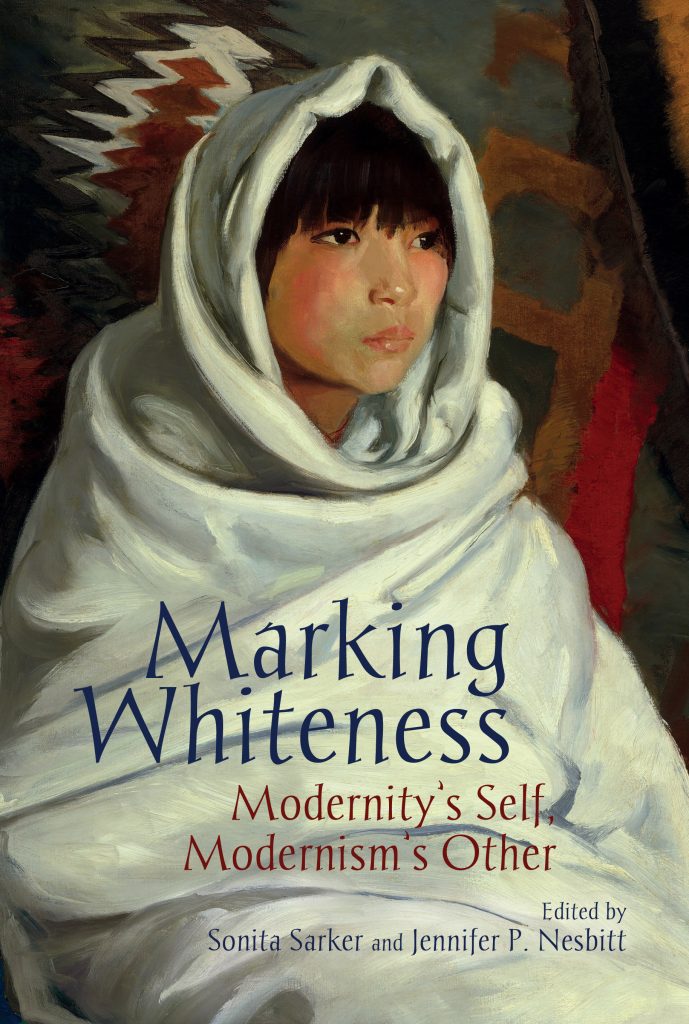
Marking Whiteness
Modernity's Self, Modernism's Other
Edited by Sonita Sarker and Jennifer P. Nesbitt
The title of the volume captures the stark absence of the acknowledgement of Whiteness at the core of Anglophone Modernism and in Modernist Studies. “Modernity’s Self” names the powerful impact of Whiteness as a process of subject construction in specific cultural moments of British late imperialism and post-Reconstruction US history. In this co-edited collection, the essays analyze both the silence around Whiteness (“Modernism’s Other”) and the consequences of marking its presence. In doing so, the volume opens up spaces to reconcile the field’s unaddressed tolerance of, if not compliance with, racist ideologies permeating both modernist cultural production and scholarship with the goal of recovering a more inclusive and diverse understanding of the field. The essays collectively respond to two questions: How can interrogating Whiteness, which is an analytical category intrinsic to modernist aesthetics and institutional positioning, change Modernist Studies as a field? What can methodologies, pedagogies, and institutional forms look like as this transition begins and continues?
The collection is divided into three parts to address the practices of Whiteness in modernist studies: Aesthetics, Intersectionality, and Inter/disciplinary Practice. We begin with aesthetics because modernism is the aesthetic produced in dynamic relation to the cultural formations of modernity: perceived rapid changes in labor, transportation, technology, and perceptions of body, mind, and even character. Essays in this section examine how the production of Whiteness is baked in as a positive value in assessing the value of cultural production. The second section focuses on the embodiment of Whiteness, primarily through the gendered and racialized female body, as a deflective practice that unmarks Whiteness while making it central to cultural crises around morality, national borders, and futurity. The third section considers the tacit prioritization of Whiteness as a positive value through institutional structures and pedagogical practice; these case studies ruminate on the generative potential of isolating and marking these effects. In each essay, scholars examine the stakes of marking Whiteness as a category of analysis distinct from, yet wholly imbricated with, racial categorization, given the potential for reification inherent in all strategies of marking.
About the Editors
Sonita Sarker, Emerita Professor at Macalester College, is currently formulating a monograph on Antonio Gramsci and Feminist Praxes, editing a forthcoming publication of the keynote speech on Virginia Woolf, Modernity, and Technology, delivered at the 33rd Annual International Conference on Virginia Woolf, CSU Fresno (June 2024), and writing an essay on Grazia Deledda in a volume Reeds in the Wind: Sardinia Beyond the Island, also forthcoming. A monograph, tentatively titled Breathing Violent Air: Whiteness in Post/Modernist Literatures in English, is in progress.
Jennifer P. Nesbitt, Professor of English and Chief Academic Officer at Penn State Brandywine, is the author of Narrative Settlements: Genre and Geography in British Women’s Fiction, 1918-1939 (2005), a study of modernist women’s writing and narratives of national belonging, and Rum Histories: Drinking in Atlantic Literature and Culture (2022), which considers the global socioeconomic legacies of colonization through one of its most ubiquitously traded products. She is currently extending her Marking Whiteness work by exploring the work of the Hedgerow Theater in Rose Valley, PA.
Introduction: Marking Whiteness: Modernity’s Self, Modernism’s Other | Sonita Sarker and Jennifer P. Nesbitt
Section I: White Aesthetics
1. Ezra Pound and the Paideuma of Race | Gabriel Quigley
2. Adrian Stokes’s Aesthetics of Whiteness | Heather H. Yeung
3. “Save that post-soul, post-black bullshit for somebody who gives a fuck”: On High Modernism and High Seriousness in Paul Beatty’s The Sellout | Lewis MacLeod
Section II: Women and the Whiteness Problem
4. The Jamesian Neurasthenia: Modernity’s Curse or Whiteness’s Shortcut | Wenwen Guo
5. Jessie Fauset’s Plum Bun, Whiteness, and the Color Line: A Novel of Morality without a Moral |Cyraina Johnson-Roullier
6. Marking White Womanhood Between the Wars: Surplus Women and Trafficked Women | Annaliese Hoehling
7. Race, The Future, and The Vote: Gertrude Colmore’s Suffragette Sally | Jeremy Colangelo
Section III: Whiteness in Inter/Disciplinary Practice
8. Gertrude Stein’s White Wines: Performing (Off)whiteness, (Un)voicing Racist Language | Jane Goldman
9. Poetics and Pedagogy of Whiteness: Rankine, Stevens, and Lyric Difficulty | Kelly S. Walsh
10. Trifles? From Susan Glaspell to Zitkála-Šá and Back Again, by Way of a Norton Anthology | Jennifer P. Nesbitt
Related Books



Details
Pages: 286 pages
Published: October 2025
Formats
Hardback
ISBN: 9781638041801
eBook
ISBN: 9781638041818
Subjects
LiteratureModernism