
By Drew Griffin, Imprint Director of Clemson Extension Publishing
Day Three of the UP Week Blog Tour asks, “What does your press do to Team UP?”
The mythos of academic publishing is often colored by mystery. Authors research, write, and revise before sending a beloved manuscript off to a publisher. If it’s accepted, the publishers then… do something, and a book emerges, fully packaged and ready for sale. Somewhere along the line, assuming the book is being peer-reviewed, authors may be asked to weigh in or make additional revisions before the manuscript is whisked back into obscurity. Throughout the process, authors are asked to trust in the skill and professionalism of those doing the work, even if they aren’t exactly sure what that work entails. There’s likely some amount of “editing” going on, capacious as the term is. Might there be a printing press? A bookbinder? A medieval monk painstakingly illuminating the first page? The world may never know.
Of course, for those of us working in academic publishing, the process is often far more mundane. Manuscripts follow a straightforward path, from submission through review, acceptance and contracting, production, and eventually publication, likely with a detour or two for permissioning or marketing along the way. Certainly, publishing professionals provide a specialized set of skills, but not secret ones. Despite this, countering the assumed impenetrability of the publication process is difficult. It seems that no matter how many informational sessions, faculty orientation modules, or professional trainings press staff offer, confusion remains.
In recent years, this uncertainty, especially concerning trust in peer-review processes and the rising costs of publication, has generated a significant amount of professional distrust of the academic publishing industry as a whole. As university presses, we stand apart from larger for-profit academic publishing outlets, and university presses across the country are making convincing cases for the value we provide. Still, those nuances too often get lost in disciplinary discontent and misinformation, which can make it even more challenging to support both prospective and published authors. At Clemson University Press, we’ve been able to counter some of this unhappiness by leveraging partnerships with campus and regional partners. By far the most successful of these initiatives has been our partnership with Clemson Cooperative Extension.
Established by the Smith-Lever Act in 1914, the U.S. Cooperative Extension system is a public-service organization dedicated to providing universities an outlet to share important research with constituents across their states. The system is simultaneously supported by the U.S. Department of Agriculture, individual state governments, and county offices across the country. In practice, USDA sets national priorities, specialists and Extension faculty headquartered at state land-grant universities or research stations conduct research, mostly in related to agriculture, natural resource management, and public health, and Extension agents in each county translate that research into programming that is offered to any and all interested individuals.
The system covers tens of thousands of employees across all fifty states, so you can probably guess that the amount of information being compiled and distributed is vast. While Extension agents use many different types of media to present programming, written work is far and away the most common. Information is distributed via blog posts, fact sheets, one-pagers, short articles, monographs, manuals, field guides, and more. Some of these publications are incredibly important, such as the USDA Complete Guide to Home Canning, which is published by the National Center for Home Food Processing and Preservation, housed within the Cooperative Extension program at the University of Georgia.
Despite the amount of written information being produced by Cooperative Extension employees across the country, however, publishing in Extension has long been a relatively amateur endeavor. The types of team responsible for supporting Extension publishing vary by state, but they are overwhelmingly offshoots of marketing and branding teams. Few have any expertise in professional publishing. Flagship publications are sometimes supported by partner publishers, such as the University of North Carolina’s publication of the North Carolina Extension Gardener Handbook on behalf of North Carolina State Cooperative Extension, but most titles are independently published. What results are published titles that are filled with important, sometimes vital, information, but which are often unpolished and limited by constraints on distribution. Many times, these titles are sold only on specific university-run webpages and distributed via printing at a campus or local print shop and then individually mailing copies to interested stakeholders.
At Clemson, as we began exploring a limited campus partnership with Clemson Cooperative Extension to support ready-for-submission book-length publications, we found an even more concerning trend. Many of the previously published titles had been poorly copyedited, if they were copyedited at all. Design was minimal and inconsistent. Most concerningly, most titles had never gone through any comprehensive permissioning or clearance process, despite the fact that Extension titles tend to include a higher-than-average number of images. In short, they contained everything necessary to give a seasoned editor nightmares.
With that in mind, the vision of our partnership expanded. Rather than simply devoting resources to supporting submission-ready publications, we established an imprint—Clemson Extension Publishing—to support all things Extension. We acquired journals in the space, including the Journal of Extension, the Journal of Youth Development, and the Journal of Rural Social Sciences. We created Extension-specific resources explaining how ideas and programs and research become professional publications, and what types of publications best suit what sorts of ideas. Most importantly, we sought out publications that were explicitly not submission-ready.
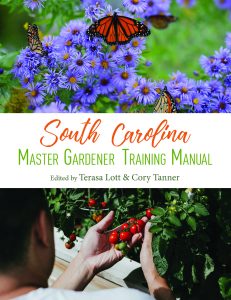
Chief among these is the South Carolina Master Gardener Training Manual, recently published in its second edition. Revising any large text is time-consuming, but typically the process is straightforward. Due to our concerns with the publication process used to produce the first edition, though, this one was not. Over nearly seven years, Clemson UP staff worked hand-in-hand with editors and authors to rebuild the book from the ground up. Diligent student workers read the first edition side-by-side with contemporaneous guides from other states to ensure that no material had been copied without permission. Three different illustrators were contracted to redesign and colorize over one hundred illustrations. Several chapters were wholly rewritten.
It was a painstaking process, and required far more individual contact hours by our editors than a traditional monograph, or even a textbook. The result, though, is a book that we are proud to publish. It’s a book that we’ll be proud to revise for a third edition, and with far less work necessary to do so. It’s a fiscally successful project for Clemson UP as well; since the manual is tied to programming offered by the university, we can guarantee a number of sales each year.
More than any of that, though, the process of revising and publishing the second edition of the South Carolina Master Gardner Training Manual was an incredibly successful effort to pull back the curtain and bring our campus colleagues into the publishing world. Because they were involved at every step of the process, the authors and editors came to understand some of the method to our (mundane and straightforward) madness. They learned why small changes can cause big delays, why attempting to make the submission document look pretty in Word only makes things harder, and why art logs spark joy. Perhaps most importantly, they gained a pretty strong sense of what each step of the process costs, why those costs are necessary, and when a quoted cost doesn’t make sense.
This knowledge echoes beyond the scope of one title, though. Since publishing the SCMGTM, we’ve received several informal proposals for new titles, or for titles that need to be revised. We’ve been approached by Extension faculty who want to discuss journal APCs; importantly, they come to these meetings not with the belief that all publishing should be free, but instead with an understanding that, while some costs are necessary, exorbitant costs shouldn’t be.
This, ultimately, is the most important reason Clemson UP values teaming UP. By committing to a partnership, albeit one that is significantly more involved than we originally planned, we’ve found a way to demystify publishing just a little bit in a way that seems to stick. In doing so, we’ve strengthened our partners, our campus, and ourselves.