
By Annalisa Federici
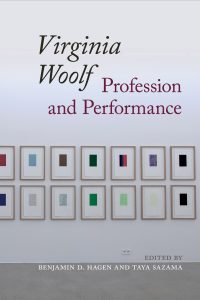
When Virginia Woolf’s essays appeared in British Vogue during the 1920s, they were not merely individual contributions to a fashionable women’s magazine. They were part of a larger editorial strategy that shaped her public profile, cultivating her image as both a serious modernist and a figure of cultural allure. In my recent essay, “‘The most brilliant novelist of the younger generation’: Appraising Virginia Woolf in Vogue,” which is a part of Virginia Woolf: Profession and Performance, I explore how Woolf’s presence in Vogue—through photographs, reviews, editorial captions, and her own essays—reveals the complex interplay between high modernist aesthetics and commodity culture.
The cultural politics of modernism have long relied on a distinction between elite and mass forms of production. Yet Woolf’s engagement with Vogue, a glossy, middlebrow periodical directed at a sophisticated but broad readership, complicates this narrative. Far from being peripheral to her career, Woolf’s contributions to Vogue—and the editorial framing surrounding them—helped solidify her reputation in the public sphere. These appearances call into question assumptions about the modernist disdain for popular culture and invite us to reassess how literary celebrity was constructed in the early twentieth century.
Woolf’s visual and verbal presence in Vogue begins with her nomination to the magazine’s “Hall of Fame” in 1924, where she is described as a “publisher with a prose style” and “the most brilliant novelist of the younger generation.” The accompanying photograph, set alongside a caption that ties her to a network of cultural figures (her father, Sir Leslie Stephen; her sister, Vanessa Bell; and her husband, Leonard Woolf), subtly asserts her legitimacy within Britain’s intellectual aristocracy. But it also repackages that legitimacy for aspirational middle-class readers, offering Woolf as both a tastemaker and a consumable figure.
To understand this dynamic, I draw on Pierre Bourdieu’s theory of the field of cultural production, particularly his distinction between restricted and large-scale production. Woolf, I argue, occupies a hybrid position. Her association with the Hogarth Press and highbrow literary circles clearly aligns her with the subfield of restricted production, where cultural capital is measured by prestige rather than profit. But her participation in Vogue suggests a strategic negotiation with the more commercial subfield, where value is determined by visibility, appeal, and circulation.
Appraisal Theory offers a complementary framework for analyzing how Woolf’s celebrity was linguistically constructed. The evaluative language used by Vogue reviewers and editors—terms like “brilliant,” “distinguished,” and “rare merit”—consistently positioned her at the apex of literary achievement. These positive judgments of esteem and appreciation, often embedded in ostensibly neutral or factual statements, functioned to elevate Woolf while aligning the magazine itself with cultural sophistication.
What emerges from this analysis is a portrait of Woolf as both an elite writer and a marketable figure. She is praised not only for her formal experimentation and intellectual rigor but also for her accessibility and charm—traits that rendered her legible and attractive to Vogue’s readership. Reviews of The Common Reader, Mrs. Dalloway, and To the Lighthouse use metaphors and comparisons (to modern painters, to poetic language, to revolutionary figures) that cast her as a visionary artist while simultaneously reinforcing her cultural cachet.
Woolf’s presence in Vogue also prompts us to reconsider the role of editors—particularly Dorothy Todd, who helmed the magazine between 1922 and 1926. Todd actively sought to elevate Vogue’s cultural status by featuring literary figures like Woolf, thereby enhancing both the magazine’s prestige and the celebrity of its contributors. Todd’s editorial strategy exemplifies what Bourdieu calls the habitus of the “double personage”—a mediator who must reconcile the opposing logics of cultural distinction and commercial viability.
In this light, Vogue’s function was not merely to reflect existing reputations but to shape them. The paratextual materials surrounding Woolf’s essays worked to define her not only as an author but as an icon of modernist sensibility. The visual presentation of her image, the evaluative framing of her work, and the juxtaposition of her contributions with high fashion and elite lifestyles all reinforced her symbolic value.
What is particularly striking is that Woolf’s inclusion in Vogue neither diminished her highbrow credentials nor fully assimilated her into mass culture. Instead, her appearance in such a venue demonstrates the permeability of the cultural boundaries that modernist criticism has often taken for granted. As I argue in the essay, Woolf’s engagement with middlebrow periodicals like Vogue challenges the supposed dichotomy between “high” and “low,” between intellectual refinement and commercial appeal. Rather than betraying her aesthetic principles, Woolf’s presence in these spaces highlights her ability to navigate—and benefit from—the circuits of celebrity and cultural production.
By placing Woolf in Vogue, Dorothy Todd helped forge a public persona that made modernism visible, desirable, and influential. In turn, Woolf’s reputation as a literary icon lent Vogue the cultural legitimacy it sought. Their relationship was reciprocal, mutually beneficial, and emblematic of a broader shift in the way modernist culture circulated in the twentieth century.