
THE BUTTERFLY GARDEN: AND 12 OTHER POEMS OF THE YEAR.
by Wayne K. Chapman. Clemson University Press, January 2026.
46 pages. $19.95 chapbook.
REVIEW by Alice Davis Keane (Queens College, City University of New York)
Wayne K. Chapman’s debut poetry chapbook, The Butterfly Garden: And 12 Other Poems of the Year, flourishes from a generative assumption: “Just as reading is said to be a journey, living memory is also textual ground ripe for travel.” In this collection of thirteen poems, arranged chronologically and comprising lyrical, occasional, and narrative texts, Chapman, a Portland, Oregon native who is a scholar of W. B. Yeats, Leonard and Virginia Woolf, and modern British, Anglo-Irish, and American poetry, brings a distinctly West Coast poetic sensibility to the page. Chapman’s work is deeply influenced by William Carlos Williams’ idea of “the new measure” and Paul Fussell’s notion of poetry’s distinguishing itself from prose by “bucking” against the norms of poetic form, as well as the Yeatsian notion of the “ghostly voice.” Indeed, as Chapman, who is Professor Emeritus of English at Clemson University and founding editor of Clemson University Press, has noted, these poems are all about “voice.”
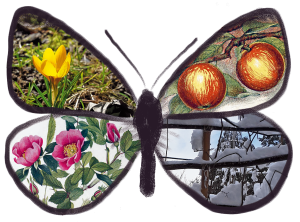 The opening poem, “The Butterfly Garden,” presents a challenge to “rekindle” the poet’s eponymous West Coast garden as both a physical place and a metaphorical setting for creative work. Chapman’s collection of “a year” begins on Valentine’s Day, evoking the importance of both art and love. A hummingbird hovers and “tries its courage” over a clump of heather that thrives in “cold mud in the rain,” stalked by a craving cat who “cannot know / the breeding imperatives / of a hummingbird in winter” (1). The cat leaps, but the hummingbird escapes, representing the beginning of a flight that will conflate this actual and metaphorical bird, in the chapbook’s closing poem, “Seeds for Spring,” with a poetic world that encompasses Yeats’s golden bird: “the work-lust of Heaney / and Gary Snyder’s ‘Hay / for Horses,’ even Yeats’s / ‘Sailing to Byzantium’” (35).
The imaginative wit of the chapbook’s second poem, “Getting Doored at 73,” is local and lexically precise. In the aftermath of a minor crash, Chapman reflects on the memory of how a “real car” used to sound, contrasted with the “thin sound” of present-day technology: “Stop-motion, expletive mine” (2). This observation inspires him to personify the “poor” automobile: “Injury is hard to assess when both cars are hurt” (2). Ultimately, the poet’s wordplay with “Semantics” redeems a forfeited day of “happiness lost.” Next, and the shortest poem of the collection, is “The Last House,” a linguistic improvisation around French, English, and “the English of numerous Irish writers. / An teach deireanach means the final house” (3), which conveys that, even as a Shakespearean “tongue” morphs and changes over time, houses and their gardens do as well. Mindful that “A house deserves a name when it becomes / the last house you expect to own or occupy,” the poet varies the strong iambic pentameter of this poem’s opening line into vers libre, ending with a question in the cadence of speech: “But how to avoid discord in mitigating fault, / a slur to the merit of an old mother tongue?” (3).
Situating his poems into a cycle of seasons over a calendar year provides Chapman with a flexible scaffolding to support thematic development, and the poems engage intertextually with literary predecessors in complex, resonant ways. For example, “Silence and Wonder” and “The Triumph of Love” both invoke William Faulkner, using an eight-line stanza structure in free verse with some subtle iambic patterning. “Silence and Wonder,” an allegorical la dolce vita poem that focuses on the poet’s early travels with his wife, gorgeously represents geographical settings in past, present and memory. This poem’s intertextual allusions to the historical and literary past are interwoven with vividly imagistic, and at times almost surrealistic, sensory detail — for instance, the “fairy patterings” (22) of Faulkner’s “Carcassonne,” from the poem’s epigraph, connect with “pattering silence” (22) and “a patter of Rincón attic rats” (23). Similarly, “The Woolfs on the Notion of Zot” and “The Woolfs on Tides” feature stylistically and substantively intricate interconnections, inspired by figures of literary modernism. “Zot,” in the poet’s coinage, is “the last increment / before zero in the countdown from night” (6) — a mathematically precise instant before dawn that inspires his philosophical reflection, as a Woolf scholar, on Leonard and Virginia Woolf’s analogous perceptions. Complicating mathematical precision, “The Woolfs on the Notion of Zot” would map to June on the cycle of the year, if this garden of poems were symmetrically arranged; instead, calling to mind Virginia Woolf’s famous observations in “Modern Fiction,” Chapman arranges the sequence of his poetic calendar in the form of Woolf’s “luminous halo.”
In “The Marabar Caves and Such Fantasies” Chapman explores Forster’s linguistic indeterminacy with the “muddle” of the Marabar (Barabar) caves, as he acknowledges “shunning” (11) the marble caves of the Siskiyou Mountains: “though I entered those cold passages once, / in 1957, I could not bring myself to do it again” (11). Weighing the risks that might accompany meddling with geographical and metaphorical caves, he confirms the wise determination: “leave them alone” (while including them in poetry and novels). In the following poem, “On Reading Joyce — Then and Again,” Chapman develops a bravura poetic imitation of Joycean prose experimentation in Ulysses, simultaneously interrogating Joycean pilgrimages in literary, historical and biographical registers. Concluding his sequence of poetic engagement with modernist experimentation in prose, in “What Price Paradise” Chapman contemplates Malcolm Lowry’s Under the Volcano, in a poem that features lush description with some chilling lines about writerly paths to be avoided: “mistaking immolation for abnegation” (27).
Oregon has been home to Chapmans for four generations, and the poet now lives with his family in Portland. In “On Turning 74,” he emphasizes what matters most: “On losing parents, one keeps on being / that son”; his children’s luck “because I remember the child I / was and still am because of them”; a closing stanza with a moving tribute to his wife (5) — observations that connect with “The Butterfly Garden” in mid-February as a wise reflection on the “good life,” encompassing love and work. In “Applesauce, or the Origin of Irony,” Chapman recounts with precise and scintillating detail formative early experiences with his extended family, including his grandmother Mary Chapman, over the course of a “good summer,” one that is followed by devastating family losses. Guided by Mary, at the age of “7 or 8” he learns to value the art of her manual farm labor, as well as its metaphorical resonances: “Chapmans do not use insecticide, so the apples / have worms. Thence most peeling and coring / leads to applesauce, requiring strong wrists and / dexterity to separate the good from the bad” (32). His grandmother’s mentorship “in a way she / probably never imagined” (33) proves formative for the future poet.
In the closing, thirteenth poem, “Seeds for Spring,” Chapman’s cyclical structure opens from a circle to a spiral, with the poet’s intention to cultivate “another garden book…the work of saving seeds for spring.” Alluding to Heaney, Snyder, and Yeats, the poet recognizes that his garden has come full circle after being rekindled in the opening poem, and the past year’s seeds are ready to generate something new. Politics is mentioned briefly, too, with an agentic response: “I’m with Voltaire and the / poets and choose to act by / plotting out another work” (36). In this Pacific Northwest garden, the bird of poetry sings splendidly, not out of nature but flying by its nets. The Butterfly Garden exemplifies a moving, triumphal quest to make meaning that endures.