
By Annaliese Hoehling
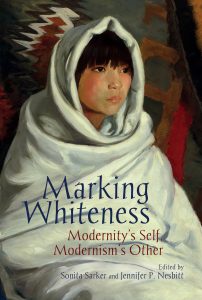
Dr. Hoehling’s chapter “Marking White Womanhood Between the Wars: Surplus Women and Trafficked Women,” appears in the recent Clemson UP collection Marking Whiteness: Modernity’s Self, Modernism’s Other, edited by Sonita Sarker and Jennifer P. Nesbitt.
What happens when a nation suddenly has “too many women”? After World War I, Britain’s 1921 census indicated there were two million more women than men in the population. Newspapers quickly began publishing letters and opinion pieces about the “problem” of Surplus Women—a generation of unmarried, middle-class women whose very existence was framed as a national crisis. At the same time, international debates over prostitution and the newly-termed “traffic in women” were gaining momentum, creating another anxious figure in the cultural imagination: the Trafficked Woman.
These tropes not only implicitly assert whiteness as a normative category but also enable (self-) policing of the intersecting borders of whiteness, womanhood, and sexuality through class and national identifications. In their literary contexts, they are kinds of narrative technology that negotiate whiteness for and between women. Together, these tropes haunted the interwar years, appearing, often subtly, sometimes overtly, in fiction, politics, and popular discourse as tools for defining which women could be counted as legitimate and productive—and which would not.
My chapter in Marking Whiteness traces some of the historical context for these figures, including the legislation and public rhetoric that fueled the tropes. Surplus Women and Trafficked Women show up not only in editorials and League of Nations reports but also in novels by Virginia Woolf, Evelyn Waugh, Ernest Hemingway, and E. M. Forster. While male authors might have mobilized these tropes to shore up white male subjecthood, I turn to two interwar novels by women—Elizabeth Bowen’s The Last September and Jean Rhys’s Good Morning, Midnight. Reading their protagonists as representations of these “surplus” or “trafficked” tropes reveals how white womanhood was imagined, regulated, and destabilized in the decades between the wars.
For example, Bowen’s Lois Farquar hovers between marriage plot and “extinction” in an Anglo-Irish Big House under threat during the “Troubles” of 1919-1921, while Rhys’s Sasha Jansen drifts through Paris in 1937 during the pre-war spectacle of the International Exposition as a figure both surplus and trafficked, teetering on the edge of erasure. Each novel demonstrates how whiteness functions as a kind of social technology for the characters—offering the promise of safety, while also enforcing boundaries of class, sexuality, and nation.
In a climactic scene in Bowen’s novel, Lois faces a turning point in which she seems offered a choice to abandon the safety of the Big House, along with everything it stands for, and the expectations to marry “well” and continue her “race.” In Rhys’s novel, Sasha finds it difficult to keep hold of her own narrative when she encounters, again and again, other vulnerable figures who, like her, have to find new communities and new identities in the cosmopolitan city to make up for lost loved ones and official affiliations.
By looking closely at these cultural tropes, we can see how the interwar period’s obsession with “too many women” or “lost women” wasn’t simply about demographics or vice—it was often about controlling intimacy, reproduction, and belonging in a rapidly changing world always about to be at war. I suggest that reading for these tropes—even across very different narratives—can serve as a method for identifying the ways that whiteness was constructed and circulated culturally and affectively during the interwar years, shaping social and psychic landscapes.
The tropes of Surplus and Trafficked Women remind us how anxieties about gender and race are woven into national and imperial histories, and how literature both reflects and resists those pressures.
This blog post was made in partnership with Liverpool University Press. Find out more about the Liverpool University Press blog here.